The Whale's Tail
Giving Thanks for the Willingness to Try
I've collected a few pieces of artwork over the years, although I suspect calling myself an art collector might be stretching things a bit. Most of my collection consists of paintings and sketches by Wyland, the marine-life artist whose fascination with whales and the ocean apparently matches my own. I love his sculptures, too, but unfortunately, his prices and my bank account have never developed quite the same relationship.
I've always been fascinated by whales, particularly that moment when one of those magnificent creatures lifts its enormous tail above the water before disappearing beneath the surface. There's something almost magical about it. For just a moment, you catch a glimpse of something extraordinary, and then it's gone, leaving you wondering about everything happening beneath the surface.
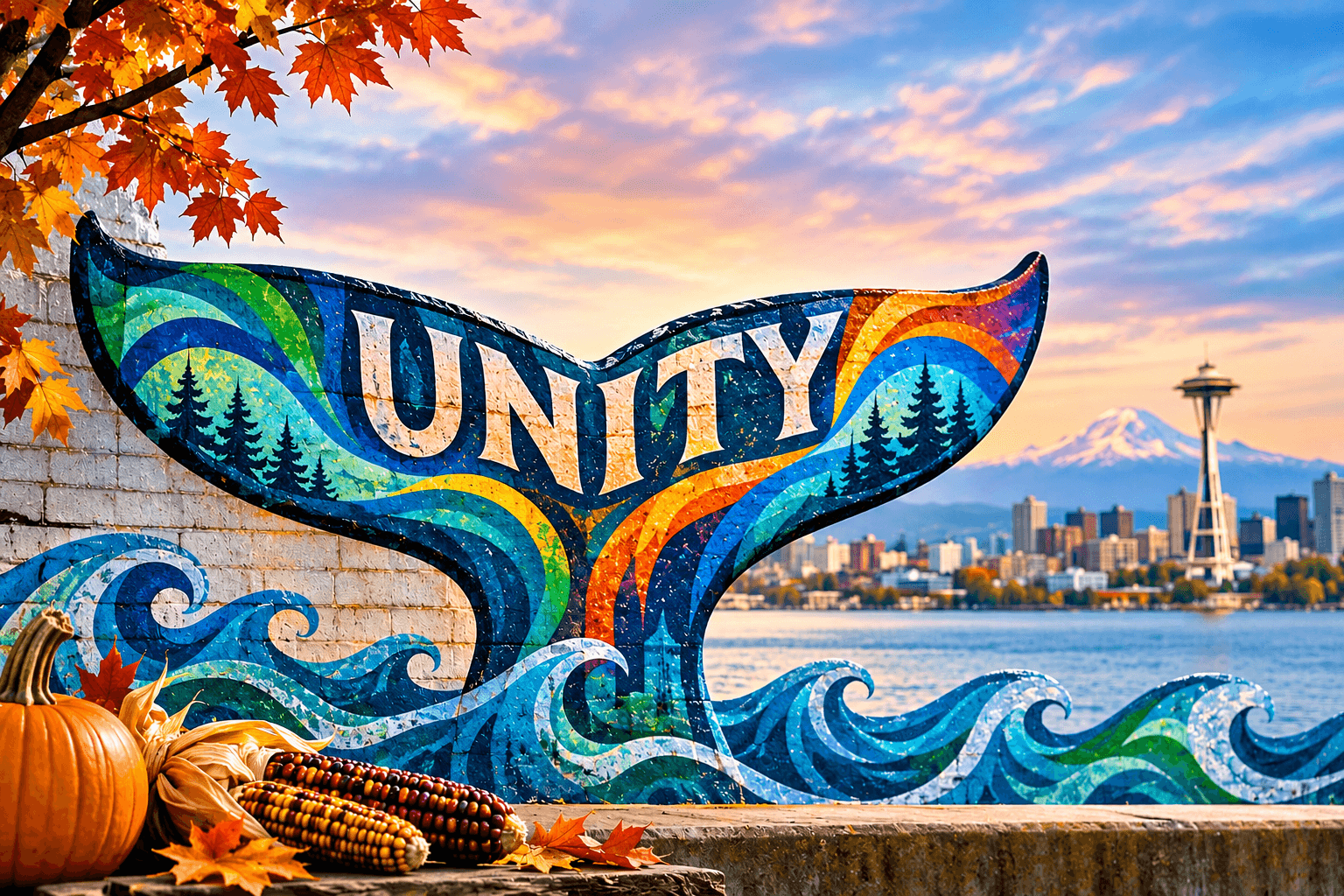
So, when Dale and I were exploring Seattle recently and I came across a colorful piece of street art featuring a whale's tail, naturally I stopped. But this particular whale tail had something else that caught my attention.
“Perhaps unity isn't the absence of differences. Perhaps it's the willingness to do the difficult work of remaining connected despite them, without asking anyone to surrender their dignity or identity in the process.”
A single word.
UNITY.
I discovered that the artwork was connected to something Seattle created for the 2026 FIFA World Cup called the Unity Loop. It's a physical and digital walking route connecting neighborhoods, parks, cultural landmarks, and some 168 places worth discovering. The idea was to encourage visitors to venture beyond the usual tourist attractions and experience the different communities that make Seattle what it is.
And unlike the World Cup itself, the Unity Loop was designed to remain long after the final whistle. I found that fascinating. Seattle wasn't asking its neighborhoods to become identical. Pioneer Square didn't have to become Capitol Hill, and the waterfront didn't have to become the Central District. Each had its own history, culture, personality, and people. The Unity Loop simply invited people to step beyond what was familiar and discover something they might otherwise have missed.
But here's what struck me most. Seattle didn't just talk about unity. It invested time, creativity, and resources into making connections possible. People had to sit down together, listen to one another, identify what was worth sharing, and then create something that invited others to participate.
And as Thanksgiving approached, I found myself wondering what might happen if we put that kind of effort into the divisions that seem to define so much of our lives today.
I've watched a church I love struggle through painful disagreements, and I've watched our country grow increasingly divided over politics, culture, and the future we want to build together. We talk about unity, of course. We pray for it, campaign on it, and occasionally give speeches about it. But sometimes I wonder whether we spend more energy explaining why we're right than discovering what we might still share.
Now, I don't want to pretend that every disagreement is easily resolved. Some involve questions of justice, dignity, and whether people are treated as fully belonging. Those differences matter, and finding common ground should never require someone to surrender their humanity.
But I also wonder whether we've become so accustomed to our divisions that we've stopped imagining ways to bridge them.
Perhaps unity isn't the absence of differences. Perhaps it's the willingness to do the difficult work of remaining connected despite them, without asking anyone to surrender their dignity or identity in the process.
On Thanksgiving, many of us will gather around tables and give thanks for the blessings in our lives. We'll be grateful for family and friends, for memories made and memories yet to be made, and perhaps for the simple gift of having someone with whom to share a meal.
But this year, I find myself particularly grateful for the people who haven't given up on the possibility of unity. The people who are still creating places where others can belong, who are willing to venture beyond what is familiar, and who believe that our differences need not be the end of our relationships.
Seattle's Unity Loop doesn't solve the world's problems. It doesn't erase differences or settle disagreements. What it does is create an invitation. It gives people a reason to leave familiar territory, encounter something new, and perhaps discover that a city is richer when its neighborhoods are connected rather than isolated.
And maybe that's what stayed with me about that whale tail. Not that Seattle had discovered the secret to unity, but that someone had decided it was worth the effort to try.
And perhaps that's where I found my Unlikely Altar. Not in the unity we have achieved, but in our willingness to keep trying to find it.
And for that willingness, this Thanksgiving, I am grateful.