
Potholes and Setbacks
Finding Grace in the Bumps You Didn’t See Coming
If you ride long enough, you’ll eventually meet a pothole. Sometimes you see it too late and hit it head-on. Sometimes you try to swerve and still clip the edge. Either way, the result is the same: a jolt that rattles your teeth, jars your confidence, and makes you wonder if your wheels are still true.
On a bike, potholes are a given. Roads crack. Asphalt crumbles. Weather wears things down. Even the best-maintained streets have weak spots. And the thing about potholes? You almost never hit them when you’re expecting to. They sneak up on you, hiding in the shadows, waiting just past the last curve.
Life has its own potholes.
- The job loss you didn’t see coming.
- The diagnosis that drops in out of nowhere.
- The phone call that changes everything.
Setbacks jar us the same way a pothole does. They shake our sense of control. They remind us how fragile things can be. And if we’re not careful, they can throw us completely off balance.
I remember one ride in EaDo
when I let my mind wander. I was in the zone, legs spinning, enjoying the day—and then wham. My front wheel found a crater I hadn’t seen. The jolt nearly knocked me over. I pulled to the side, heart pounding, and checked my bike. The wheel held, but the hit had me rattled the rest of the ride.
That’s the thing about setbacks—they echo. After you’ve been jarred, even small bumps make you flinch. It takes time to trust the road again.
And I’ve felt that same echo in life. I’ve been blindsided before—times when everything seemed smooth and then suddenly, the bottom dropped out. Ministry shifts I didn’t expect. Friendships that cracked. Health challenges that made me feel more fragile than I wanted to admit. Just like on the bike, those potholes left me cautious, hesitant, scanning the horizon for the next crack in the road.
When I hit a pothole on the road, my first reaction is usually not very holy. I grumble about the city workers who should’ve filled it. And if the jolt is especially bad, well… let’s just say a few words come out that you won’t find in the hymnal.
But the truth is, we do the same thing in life. Something knocks us off balance, and our first instinct is to point a finger. Sometimes we turn it on ourselves, replaying the “what ifs” and “should haves” until we’re dizzy. Sometimes we turn it on others, blaming people who hurt us, failed us, or just happened to be standing too close when things fell apart. And sometimes—if I’m honest—we even point it at God, wondering why the road wasn’t made smoother in the first place.
Here’s the problem: blame never fills the hole. It doesn’t fix the wheel. It just keeps us stuck, staring at the crack in the road instead of finding a way forward. Blame feels satisfying for about five minutes, but it doesn’t heal anything. What actually helps is taking a deep breath, naming the hurt, learning what we can—and then pedaling on.
Here’s something every cyclist figures out sooner or later: if you lock your eyes on the pothole, you’re probably gonna hit the pothole. It’s like your bike reads your mind and says, “Oh, that’s where you’re looking? Great, let’s go there.” And worse, if you stare too long at what you’re trying to avoid, you might miss the car, the curb, or the rider right in front of you. Suddenly, the pothole isn’t your biggest problem anymore.
Life works the same way. If all I can see is the setback—the thing that went wrong—I’ll end up running headfirst into it again, or crashing into something else entirely. The better move is to lift my eyes, find my balance, and look for a smoother path forward. Sure, potholes sting. They can bruise your pride or even bend your rim. But they don’t have to end the ride.
Looking back, I realize potholes have taught me something important: smooth pavement is nice, but it rarely makes me stronger. It’s the potholes that remind me to stay alert, to pay attention, to appreciate the stretches of road that are even and kind. In life, setbacks can do the same. They teach us resilience, humility, patience. They remind us that perfection isn’t promised, but perseverance is possible.
For me, even the pothole becomes an Unlikely Altar.
It’s the place where frustration turns into prayer—sometimes an angry prayer, sometimes a desperate one, sometimes a simple sigh. The jolt in the road reminds me that I am not in control, but I am not alone. And somehow, grace shows up in the shaken balance, the deep breath, the steadying of hands on the bars.
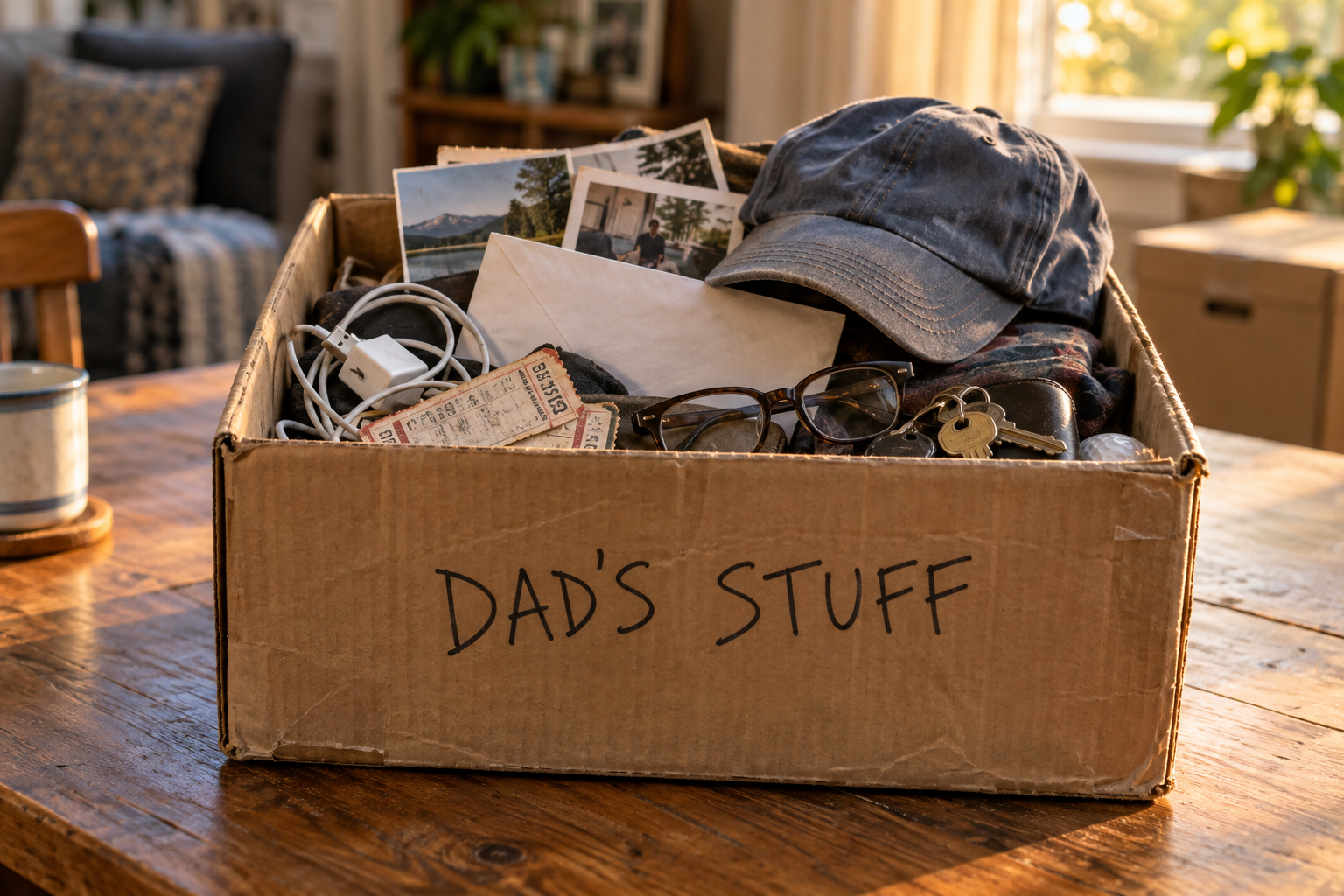
Someday after I die, my sons are going to have to go through my stuff, and I have to admit that I find this thought both amusing and a little terrifying. Not because I'm hiding anything particularly scandalous, or at least nothing they'll be able to prove, but because I know how much stuff I've accumulated over the years that makes perfect sense to me and will make absolutely no sense to them. I can already picture it. One of them will open a drawer, pull out some completely inexplicable object and ask the other, “Do you have any idea why Dad kept this?” The answer will almost certainly be no. Eventually somebody will say, “We probably shouldn't throw it away,” and into a box it will go. That box will be labeled DAD'S STUFF and moved from closet to closet for the next twenty years because apparently one of the things we inherit from the people we love is the inability to throw away their weird crap. That's funny when we're talking about old ticket stubs, charging cables, or whatever other treasures my children someday discover. It becomes considerably less funny when the thing they're trying to find is an insurance policy, a bank account, an important password or the answer to a very simple question: What did Dad want us to do? I've spent enough time around death to know that dying leaves behind more than grief. It leaves behind an astonishing amount of administrative work, and unfortunately the electric company, Netflix and the HOA don't receive some cosmic notification that says, “Marty died Tuesday, please stop sending him bills.” The financial machinery of a person's life keeps humming along until somebody who is very much alive starts shutting it down. That's something we don't talk about much when we talk about “final expenses.” We usually mean the funeral, and certainly that's part of it, but the funeral isn't the only bill that survives us. There is a strange stretch of time between someone's death and the moment their financial life finally comes to rest, and somebody has to live through that stretch. Usually, that somebody is a person who loved us, and they're doing all of this while grieving. They may be planning a funeral while trying to figure out whether the mortgage has been paid, which bills are automatically drafted, how long the electricity needs to stay on and what accounts need to be closed. Someone may have to miss work or travel. There may be a car to sell, subscriptions to cancel or a dog that suddenly needs somewhere to live. I've seen enough grief to know what it can do to an otherwise perfectly capable person. People forget things. They read the same piece of paper three times and still aren't sure what it says. They can make a dozen decisions at the funeral home and then become completely overwhelmed deciding what everybody should eat for dinner. Yet right in the middle of all that, we sometimes leave them a scavenger hunt. Where's the will? Did Mom have insurance? Who's the beneficiary? Where does Dad bank? What's the password? And eventually, “ Why in God's name was he still paying $14.99 a month for this?” The more I think about it, the more I wonder whether planning for our death is less about having everything perfectly arranged and more about simply leaving fewer questions. Most of us aren't going to leave behind a beautifully organized binder with labeled tabs containing everything our family could possibly need. If you have one of those, congratulations. I admire you and also find you slightly suspicious. The rest of us can at least tell someone where the important things are, what we've already arranged and what we want done. And if we have life insurance, perhaps we should make sure the person we've named as beneficiary actually knows the policy exists. That's also why I've started thinking differently about final expense insurance. Yes, it can provide money for a funeral or cremation, but it can also provide something less obvious: a little financial breathing room during that strange period when someone is grieving you while simultaneously trying to wind down the life you left behind. It isn't supposed to turn someone's death into a payday, nor does everybody need a huge policy. It’s simply money that’s there when the person you chose as your beneficiary needs it, without you having to predict which expense is going to arrive first. Maybe “final expense” is actually a misleading name because death doesn't come with one final expense neatly printed at the bottom of a receipt. It comes with bills, responsibilities, decisions and questions, and eventually the people who love us have to sort through all of them. Someday my sons really will go through my stuff. They'll throw some of it away, keep some of it and probably find a few things that make them wonder what exactly was wrong with their father. I hope they laugh. I hope they find things that bring back stories and, for a moment, bring me back into the room with them. But here's what I don't want. I don't want what I leave behind to become something they have to carry. I can't spare them the grief of losing their father someday. There isn't an insurance policy in the world that can do that. But I can leave fewer questions, make a few decisions now instead of leaving those decisions to them and provide some financial breathing room for whatever that day brings. Maybe that's what a loving legacy looks like. We can't make death easy for the people we love, but we can try to make what comes after it a little easier. Because death doesn't cancel autopay. But love can plan ahead.

I went to see the new Spider-Man movie, got myself tangled up in thoughts about webs, connection, and our rather inconvenient need for other people, and decided I had found the Unlikely Altar . I even wrote about it in my last blog, Trust the Web . I figured I was done with Spider-Man . But I guess Spider-Man wasn't done with me. One day as I was driving home from a funeral home, I heard something that made me think about the movie all over again. I was listening to a podcast, The Big Picture, and one of the hosts, Amanda , said something almost in passing. She said the real villain of the Spider-Man movie was loneliness . The other hosts didn't really acknowledge it and the conversation moved on. But I couldn't shake it. The more I thought about it, the more I wondered if she had seen something hiding in plain sight; something that I might have missed. The trailer tells us that Spider-Man is up against " a powerful villain no one can even see. " Maybe that's not just a clue about the movie's mystery. Maybe it's the movie's deepest truth. Because loneliness was everywhere in the story. It was there every time Peter Parker walked past someone who used to know him and didn't get so much as a second glance. It was there when he sat alone in an apartment that used to be full of people. It was there in the quiet, unglamorous fact that the world had simply moved on without him. Nobody made a big deal about it. Because that's not how loneliness usually works. It doesn't announce itself, instead it just keeps piling on. It is that way in this movie and it is that way in real life. The strange thing about loneliness is that there isn't just one way it finds us. Sometimes it finds us when someone dies. Sometimes a marriage ends, or a friendship that once seemed permanent quietly disappears. And sometimes nothing dramatic happens at all. We're just lonely. I mentioned this idea for the blog to a good friend of mine, and his response stopped me. His mother recently lost her husband and now lives with him and his family. She isn't alone. There are people in the house who love her. There are meals and conversations and all the ordinary movement of family life around her. But her world has been getting smaller. Her husband is gone. She can no longer drive. Friends who once called or texted don't seem to anymore. "Mom is experiencing that now," he told me. "Even with us around." And then he said something I haven't been able to forget. "I see it every day." Maybe that's what we misunderstand about loneliness. We sometimes treat it like a math problem. Put enough people in the room and loneliness should disappear. But it doesn't work that way. Sometimes you can be deeply loved and still deeply lonely. What you miss isn't " people " - - you miss a particular person, a particular life. The one who knew how you took your coffee. The familiar voice from the other room. The freedom to get in the car and go somewhere, the job where people knew your name, the routines you never realized were holding your world together until they were gone. Maybe loneliness isn't always an empty room. Sometimes it's the empty spaces left inside a life that is still very much full of people. I've seen that kind of loneliness in my work. I've seen it at funerals where a widow or widower is surrounded by a room full of people who genuinely love them, while knowing that eventually everyone will go home. And so will they. Except they will go home without the one person they desperately wish were going with them. I know something about that kind of loneliness too. Chances are, you have too. Sometimes it lasts an evening and then there are times when it lasts much longer. Sometimes we know exactly why it's there, and sometimes we couldn't explain it if we tried. We can be lonely in an empty house. We can also be lonely at a crowded table. Maybe that's why loneliness makes such a good villain. It doesn't need a mask . It hides in the quiet apartment, the empty side of the bed, the phone call you don't make anymore. Nobody claps when it's defeated because most of the time nobody else even knew it was there. And I don't think Spider-Man ever really beats it. Not for good. But then I'm not sure any of us do. Maybe that's because loneliness isn't always something to be defeated. Sometimes there is no fixing the empty side of the bed. No replacing the person who knew how you took your coffee. No giving someone back the life they had before the world changed. Maybe, for now, the point is simply to notice. Not because noticing leads somewhere, not because it's the first step toward fixing anything. It doesn't solve the math. Counting heads in a room never made anyone less lonely, and neither will counting the people who noticed. Noticing isn't a means to an end here — it's the whole point. That's the Unlikely Altar this time. Not the web itself, but the moment somebody stops and sees the person standing in it, caught, and says so out loud. Amanda, catching it in a sentence almost nobody else heard. My friend, seeing it in his mother every day, in a house full of people who love her. Somebody, once, seeing it in me. Maybe that's how we keep weaving the web. Not by making loneliness disappear. By making sure the lonely don't disappear with it.
I have reached the age where I watch superhero movies differently than I used to. Don't get me wrong. I still enjoy the explosions, the impossible stunts, and the inevitable scene where New York is somehow once again hanging by a thread. But somewhere along the way I've become the guy who walks out of the theater thinking less about the villain and more about what the story says about being human. That happened again after watching the new Spider-Man movie, Brand New Day. As I thought about the movie, I found myself wondering what Spider-Man's greatest invention really is. At first, I thought it was the suit. It is definitely iconic, but I remembered his best suit wasn't even his own invention. That one? It was designed, built and provided by Tony Stark. So maybe it's his strength, except there are plenty of superheroes who are stronger. Or perhaps it's the ability to swing effortlessly between skyscrapers. As amazing as all of that is, I don't think it's his greatest gift. No, for me, the best, greatest, and yes, maybe even the holiest thing Spider-Man does has always been about the web. A single strand of a spider's web is almost nothing. You can brush it away with the back of your hand and never think twice about it. But strand after strand, woven together with patience and intention, becomes something remarkably strong. Maybe the web was never just a clever way for Spider-Man to get around the city. Maybe it was always pointing toward something truer about the way life actually works. Isn't it interesting? Spider-Man doesn't fly. Superman flies. Iron Man flies. Captain Marvel flies. Spider-Man can't. Every single movement forward depends on attaching himself to something outside himself. The more I thought about that, the more I wondered if the web isn't really a superpower at all. Maybe it's simply a picture of what it means to be human. For a long time, Spider-Man tries to carry everything by himself. He keeps people at a distance, convinced that if he just works a little harder, sacrifices a little more, holds on a little tighter, he can protect everyone he loves. It's a noble instinct. It's also an exhausting one. Eventually he learns what most of us spend a lifetime learning. There are some battles you simply cannot fight alone. Most of us have been taught that the strong life is the independent life. We admire the person who never asks for help, never leans on anyone else, never lets the world see them struggle. We confuse self-sufficiency with maturity. But that's not how Spider-Man survives. Even with all his strength, every swing depends on being connected to something beyond himself. Notice what the web is actually for. Yes, it blocks a punch. It disarms a villain. It restrains someone twice his size. But its quietest work is something else entirely. It keeps him connected to something solid when he has nothing else to stand on. And just as often, it's the thing that catches someone else before they hit the ground. Once I saw it, I couldn't stop seeing it. I've seen the web in hospital waiting rooms. I've seen it around kitchen tables after someone dies. I've seen it in churches, neighborhoods, baseball dugouts, recovery groups, and around backyard grills. And I've certainly seen it in the hundreds of funerals I've had the privilege to lead. I've never watched a family survive the hardest day of their lives because one person was exceptionally strong. They survived because someone brought dinner. Someone answered the phone. Someone took the kids for the afternoon. Someone sat in silence. Someone refused to let them grieve alone. That's what held them. We spend years weaving these webs without thinking very much about them. Then one day life asks them to hold our whole weight. That's when I realized something. Not all altars are made of stone. Some are woven. Maybe that's the Unlikely Altar. It's not the skyscrapers or the mask. It's not even the superhero. The Unlikely Altar is the web — the ordinary, almost invisible network of relationships that catches us when we fall, steadies us when we lose our footing, and quietly reminds us that none of us was ever meant to swing through life alone. Maybe that's the whole sermon, if you can call it that: Trust the web. And whenever you can, become part of someone else's.